Benodebehari Mukherjee (1904 -
1980) - Murals
Centenary
Retrospective Exhibition curated by Gulammohammed
Sheikh & Siva Kumar
New Delhi: December 30th 2006 - February 11th
2007
Acknowledgements

Text - R.Sivakumar
GM & Nilima Sheikh
Identification of Japan trip photos -
Omuka Toshiharu
Tsutomu Mizusawa
Design and formatting of CD -
Pushkar Nagwekar,
Kinjal Vora,
Sukhdev Rathod,
Sanjoy Kumar Malik
Voice -
Indrapramit Roy
In Santiniketan,
murals and other public art projects were used
to get teachers and students to work together
like members of erstwhile guilds, passing on
insights and skills through acts of
collaboration, as a means for taking art into
the everyday life of the community. Although he
often pictured himself as a recluse of a kind,
Benodebehari showed an early interest in mural
painting. He saw in murals, above everything
else, an opportunity to work on a scale more
ambitious than what folios and scrolls permitted
and to present his vision of the world more
comprehensively.The first of his more
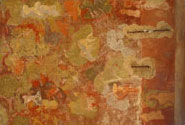
significant murals is a representation of the
local landscape he painted on the ceiling of a
hostel dormitory in Santiniketan in 1940. In
this mural he gathers his experience of the
local villages in an encyclopedic manner and
unrolls it around a central pond like an
intricate web of images that carry us to the
four corners of the ceiling constantly shifting
perspective and focus to invoke the experience
of an itinerant viewer.
His next mural done two years later in Cheena
Bhavana is structured like a Japanese screen. It
knits together vignettes of campus life
cunningly juxtaposed into a gestalt which uses
suggestion and innuendo.
While these two murals invite an intimate
engagement of viewers his next and most
important mural, based on the lives of the
Medieval Saint Poets of India, works on an
altogether different footing. Painted between
1946 and 1947 (assisted by Jitendra Kumar, Leela
Mukherjee, Devaki Nandan Sharma and
K.G.Subramanyan) the mural on three walls of the
Hindi Bhavana is about eighty feet in length.
Spanning the upper half of a room and running
across its three walls like a long tracking film
shot, it presents a vision of the Indian past as
an elaborate pageant. Its teeming figures, with
variously poised bodies and gestures achieve a
pulsating rhythm by measured shifts in focus,
its invocations of history and timelessness, and
the many levels of reading and meaning. It is
arguably, the most ambitious murals of modern
India.
Another fine example of this middle phase of his
career is in the two panels at the Vanasthali
Vidyapeeth in Rajasthan done in 1950.
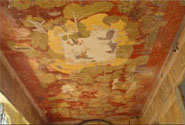 |
Village Life in Birbhum,
mural in egg tempera,
size 2.53 x 6.06 meters,
1940, |
|
|
|
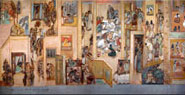 |
Life on the Campus,
Cheena
Bhavana, mural in fresco
secco,
total length 5.55 meters,
1942 |
|
|
| |
|
|
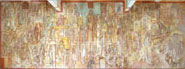 |
Life of Medieval Saints,
(detail),
mural in fresco buono,
23.07meters height 2.44
meters |
|
|
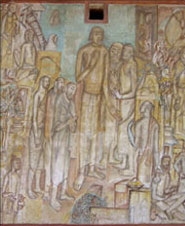 |
Ramanuja (detail),
Life of
Medieval Saints, Hindi
Bhavana |
|
|
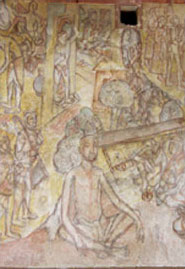 |
Kabir (detail),
Life of Medieval Saints |
|
|
| |
|
|
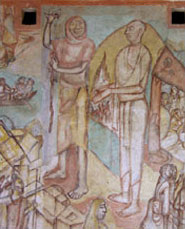 |
Tulsi Das (detail),
Life of Medieval Saints |
|
|
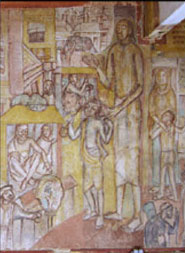 |
Sur Das (detail),
Life of Medieval Saints |
|
|
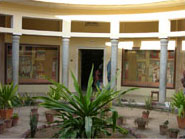 |
Banasthali Vidyapeeth
mural site |
|
|
| |
|
|
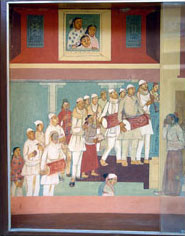 |
Nepalese Festival
Procession
mural in Jaipur fresco,
each panel approximately
2.36 x 3.29 meters, 1950 |
|
|
|
|
| |
|
|
| |
|
|
|